Be yourself; Everyone else is already taken.
— Oscar Wilde.
This is the first post on my new blog. I’m just getting this new blog going, so stay tuned for more. Subscribe below to get notified when I post new updates.
Be yourself; Everyone else is already taken.
— Oscar Wilde.
This is the first post on my new blog. I’m just getting this new blog going, so stay tuned for more. Subscribe below to get notified when I post new updates.
In her 2016 article, “Teachers, Social Media, and Free Speech,” doctoral student Mandy Vasek addresses the consequences surrounding teachers and their increasing use of social media to connect with students and parents. Exploring the positive and negative aspects of educators and social media use, Vasek considers our first amendment when enforcing limited use of social media platforms between teachers and students. In exploring an argument that poses a threat to freedom of speech, Vasek develops her credibility through unbiasedly exploring both sides of the conflict as well as successfully establishing logos through several court case references.
Reaching back to the court case Pickering v. Board of Education, Vasek strongly establishes ethos by building credibility as well as providing data of a flawed system where an educator was not able to respectfully speak what was on his mind. The credibility brought on by these references lies in the appreciation of Vasek’s historical knowledge and thoroughness on the subject. Vasek continues to provide data through court cases where the teacher’s were clearly wrong, such as her reference to the case Spanierman v Hughes that occurred in 2008. The strength in using this particular case somewhat established pathos since the case is incredibly relevant to parents who worry about their children’s internet usage and safety. By providing a more recent court case reference, Vasek continues to build her ethos by once again establishing the level of her knowledge and research.
In conclusion, Vasek sums up her data by claiming that the key to such an argument is to find balance between cautiously speaking your mind and potentially posting inappropriate content that your students have access to. Vasek’s conclusion claims “School leaders should incorporate the appropriate and inappropriate use of social media in professional development programs and take advantage of the didactic potential of cases like Spanierman, Munroe, and Land as cautionary tales” (Vasek 8).
Vasek, Mandy, and Randy Hendricks. “Teachers, Social Media, and Free Speech.” EJEP: EJournal of Education Policy, Jan. 2016. EBSCOhost, search.ebscohost.com/login.aspx?direct=true&db=eric&AN=EJ1158122&site=ehost-live.
Blog Post 2
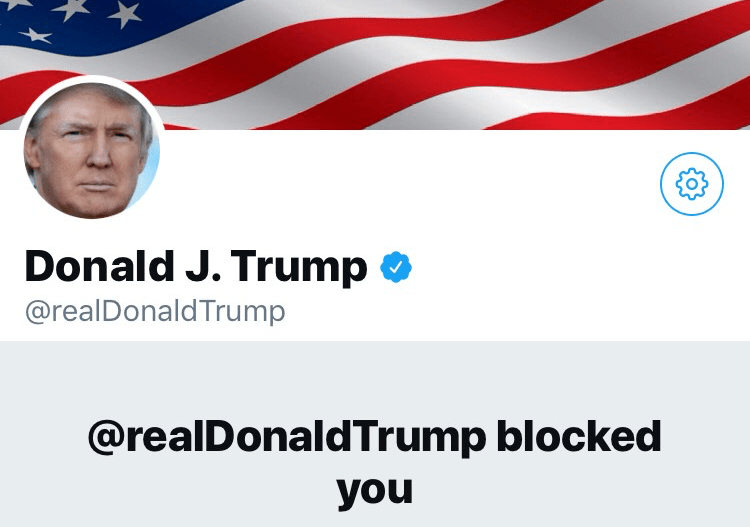
With President Trump being the first president to fully engage himself in the world of Twitter, the question of whether or not Trump’s use of the block feature on the social media platform is a violation of the first amendment sparked a debate. In the 2019 article by Lauren Beausoleil, Is Trolling Trump A Right or a Privilege?, we discover that the court case of Columbia University v. Trump resulted in the court’s decision that the blocking of fellow Twitter users is held within public forum, therefore deeming blockage unconstitutional. The thorough analysis of each side of this debate built upon Beausoleil’s credibility as an unbiased commentator. Although she thoroughly deciphers both sides of the argument, Beausoleil’s stance is clearly stated. In response to the courts decision, She respectfully claimed that “this error is especially problematic in light of increasing scholarly criticism of courts for applying the public forum doctrine in an inconsistent, subjective manner that obscures the boundaries of the doctrine” (Beausoleil II.-32). As somebody who believes that government interference in social media platforms must be enforced to an extent, I am curious to hear other’s perspectives on where we should draw the line. I strongly believe that if Trump isn’t able to block other users on Twitter, nobody she be able to block other users on Twitter. I say this with the obvious understanding that Trump’s content is often important when considering his position in office, but let’s be honest, much of his content is ignorant and often distasteful. In my opinion, claiming that being blocked from trolling his Twitter feed is indeed a violation of our Freedom of Speech is quite a reach. In conclusion, Beausoleil’s stance agrees with my belief that Trump’s blocking of Twitter users is in no way a violation of our first amendment. By assessing the court’s incorrect application of public forum analysis, Beausoleil strongly provided evidence that strengthened her argument.
BEAUSOLEIL, LAUREN. “IS TROLLING TRUMP A RIGHT OR A PRIVILEGE?: THE ERRONEOUS FINDING IN KNIGHT FIRST AMENDMENT INSTITUTE AT COLUMBIA UNIVERSITY v. TRUMP.” Boston College Law Review, vol. 60, Dec. 2019, pp. 31–46. EBSCOhost, search.ebscohost.com/login.aspx?direct=true&db=a9h&AN=141165131&site=ehost-live.
This is an example post, originally published as part of Blogging University. Enroll in one of our ten programs, and start your blog right.
You’re going to publish a post today. Don’t worry about how your blog looks. Don’t worry if you haven’t given it a name yet, or you’re feeling overwhelmed. Just click the “New Post” button, and tell us why you’re here.
Why do this?
The post can be short or long, a personal intro to your life or a bloggy mission statement, a manifesto for the future or a simple outline of your the types of things you hope to publish.
To help you get started, here are a few questions:
You’re not locked into any of this; one of the wonderful things about blogs is how they constantly evolve as we learn, grow, and interact with one another — but it’s good to know where and why you started, and articulating your goals may just give you a few other post ideas.
Can’t think how to get started? Just write the first thing that pops into your head. Anne Lamott, author of a book on writing we love, says that you need to give yourself permission to write a “crappy first draft”. Anne makes a great point — just start writing, and worry about editing it later.
When you’re ready to publish, give your post three to five tags that describe your blog’s focus — writing, photography, fiction, parenting, food, cars, movies, sports, whatever. These tags will help others who care about your topics find you in the Reader. Make sure one of the tags is “zerotohero,” so other new bloggers can find you, too.

 Kamryn's Blog